The latest KPMG Switzerland Clarity on Swiss Private Banks study invites a question more fundamental than the technologies currently dominating the industry debate: are Swiss private banks still converting money into value efficiently?
Assets under management are not the output of a private bank. They are an input. Markets, advice, credit, structuring, allocation and service are the transformation engine. The expected output is value for clients, shareholders and the wider economy.
Between 2021 and 2025, the sector’s AuM increased by 9.7%. That growth was respectable, but modest compared with several major equity indices over a broadly similar period. The comparison must be treated cautiously because private-banking books include cash, bonds, conservative mandates, currency effects, withdrawals, net new money and acquisitions.
Its purpose is not to equate a diversified client portfolio with an equity index. It is to remind us that AuM growth alone says little about performance. The relevant question is what happened after those assets entered the operating model.
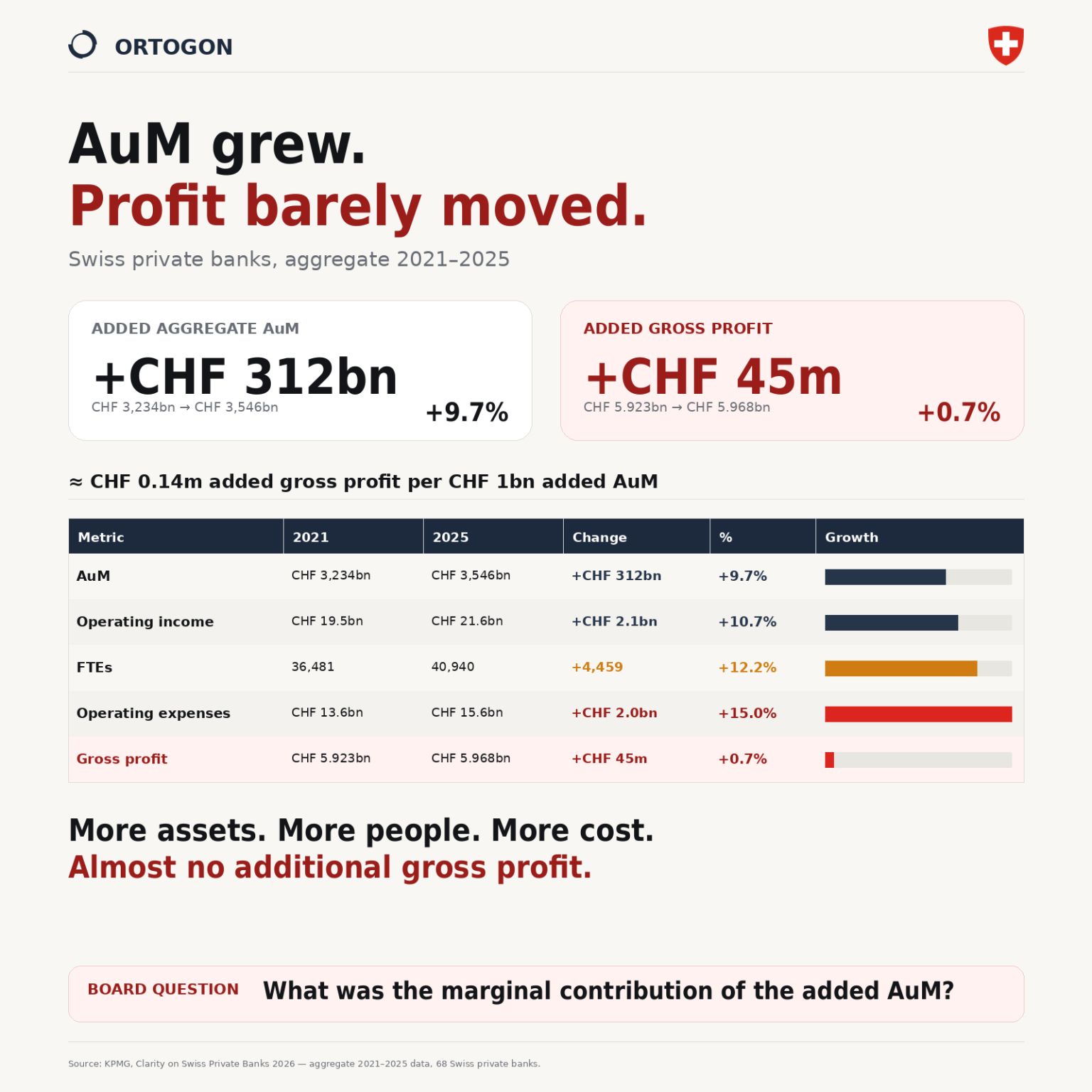
KPMG’s aggregate 2021–2025 figures show AuM up 9.7%, operating income up 10.7%, full-time equivalents up 12.2%, operating expenses up 15.0% and gross profit up only 0.7%.
In absolute terms, the sector added approximately CHF 312 billion of AuM while gross profit increased by around CHF 45 million. More assets were accompanied by more people and still more cost, with very little additional gross profit.
This is the marginal-AuM problem. In a healthy scale model, the next CHF 1 billion of assets should improve operating leverage. Revenue should rise faster than cost, profit per employee should improve and the platform should absorb volume more efficiently.
When that does not happen, additional AuM may represent administrative mass rather than economic value. The assets may be expensive to acquire, costly to serve, weakly priced or insufficiently converted into mandates, lending and other relationship revenues.
Boards and executive teams should therefore look beyond the amount of AuM added. They should ask what marginal contribution it produced, what complexity it introduced, whether it improved productivity and whether the platform became more or less efficient as it grew.
The sector remains strong, resilient and globally relevant. The challenge is not to dismiss AuM growth, but to apply greater discipline to the economics of each additional franc of assets.