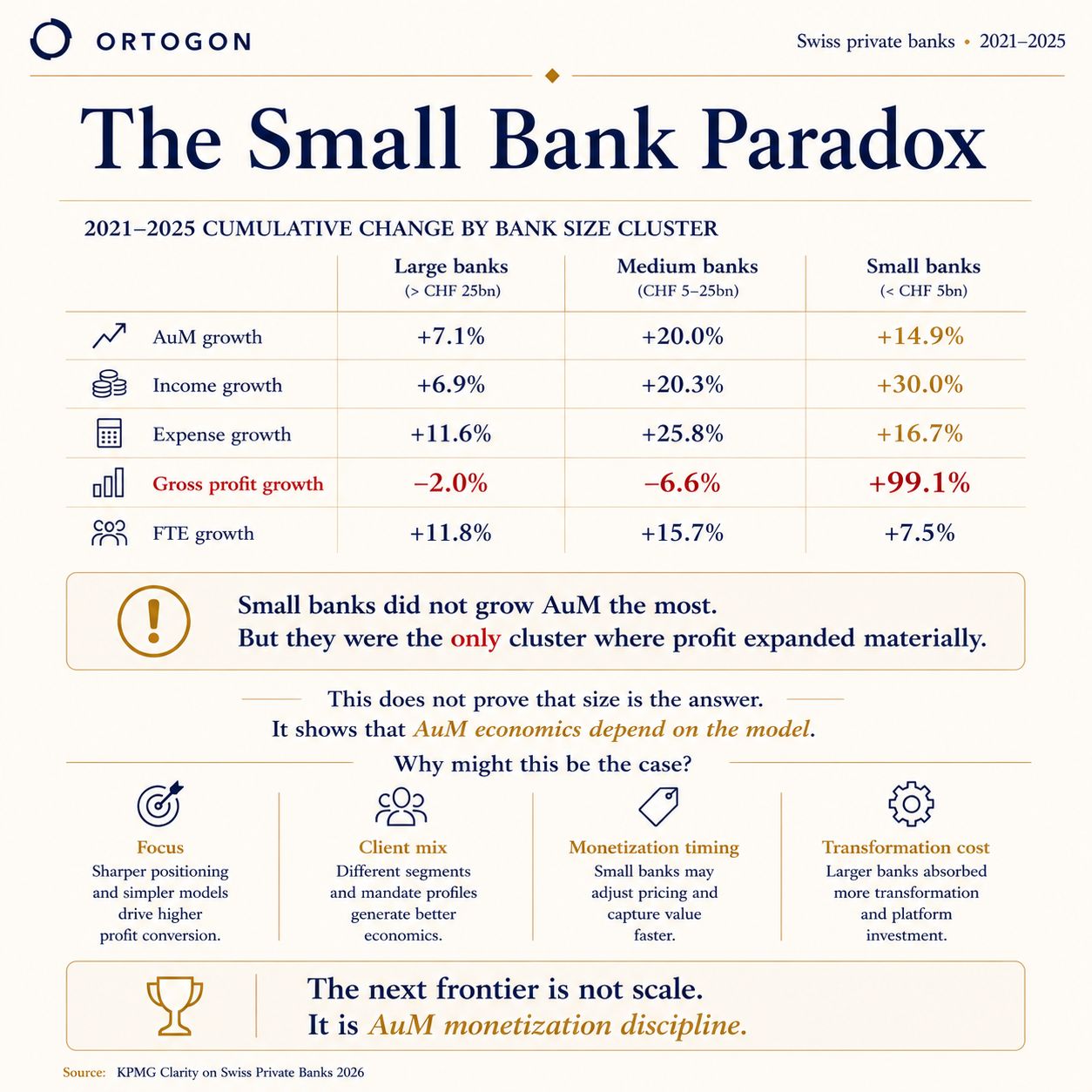
The small-bank paradox should not be read too quickly. In the 2021–2025 data, smaller Swiss private banks appear to have converted AuM into profit more effectively than larger institutions.
At first sight, that result challenges the usual assumption that scale should dominate. It does not, however, justify the simple conclusion that small is better. Size alone does not explain profitability.
One interpretation is focus. Some smaller banks may benefit from clearer client segments, closer relationships, faster decisions, stronger pricing discipline and lower internal complexity. In that case, the advantage comes from a more coherent operating model rather than size itself.
A second interpretation is client mix. Smaller banks may not be adding the same kind of AuM as large platforms. Their performance may reflect consolidation by existing clients, lower acquisition costs, niche positioning or relationships in which proximity still supports a pricing premium.
A third interpretation is strategic pricing. Large platforms may accept lower current margins on selected clients because they expect to monetize the relationship later through credit, mandates, private markets, structuring or broader wallet share. The relevant issue then becomes whether that future conversion actually occurs.
A fourth interpretation is transformation cost. Larger banks may be carrying heavier investments in compliance, controls, cybersecurity, platforms, integration and operating-model renewal. Those costs can depress current profitability while building future capacity—or they can become permanent complexity. The two should not be confused.
The paradox is therefore not primarily a story about scale. It is a story about business-model coherence and the system through which assets are acquired, served, priced, controlled and monetized.
Boards and executive teams should compare acquisition cost, cost-to-serve, compliance burden, platform cost, pricing discipline and lifetime value across client and operating-model segments. Aggregate averages are unlikely to reveal where the difference is created.
The practical objective is to identify where the bank creates leverage, where it absorbs complexity and where apparent scale is failing to produce economic scale.
The next frontier is not size alone. It is disciplined monetization.