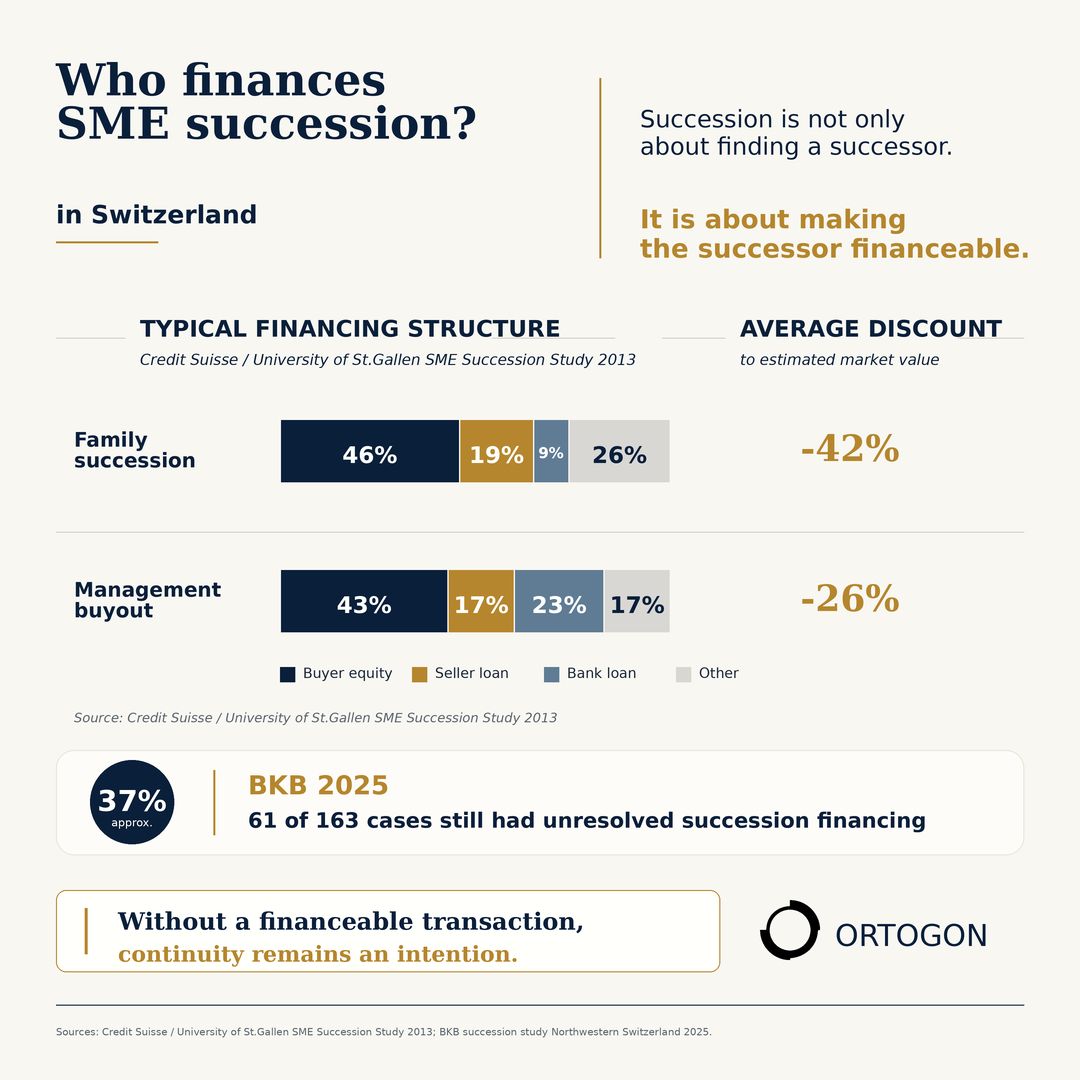
Business succession is often imagined as a simple transaction: the buyer pays, the bank finances, the founder exits and ownership changes hands. Swiss succession studies suggest a more complex reality.
A University of St. Gallen and Credit Suisse study cited in the source material reported that selected components of a typical family succession included roughly 46% buyer equity, 19% predecessor financing and 9% bank debt. For management buyouts, the cited components were approximately 43% buyer equity, 17% predecessor financing and 23% bank debt.
The figures are indicative rather than a complete template, but their message is clear. Banks matter, yet they are only one part of the financing structure.
The founder often remains economically involved after the legal transfer. That involvement may take the form of a seller loan, staged payments, an earn-out, retained equity or a concession on the sale price.
The need is not merely historical. A Basler Kantonalbank study on SME succession in Northwestern Switzerland, also cited in the source material, found that financing had not yet been clarified in 61 of 163 cases.
This is the practical bottleneck. Finding a willing successor is not enough; the transaction must make that successor financeable without leaving the company unable to invest or exposing the founder to risks that were never intended.
Financeability depends on the interaction between valuation, sustainable cash flow, buyer equity, debt capacity, collateral, repayment timing and the seller’s willingness to remain involved. Changing any one of these variables changes the entire transaction.
Succession finance therefore requires an integrated structure rather than a single funding product. Bank debt, buyer capital and seller support must be calibrated to the resilience of the business after the transfer.
Without a financeable transaction, continuity remains an intention rather than a completed succession. The question is not only who will own the next generation of Swiss SMEs, but who will make that ownership economically viable.