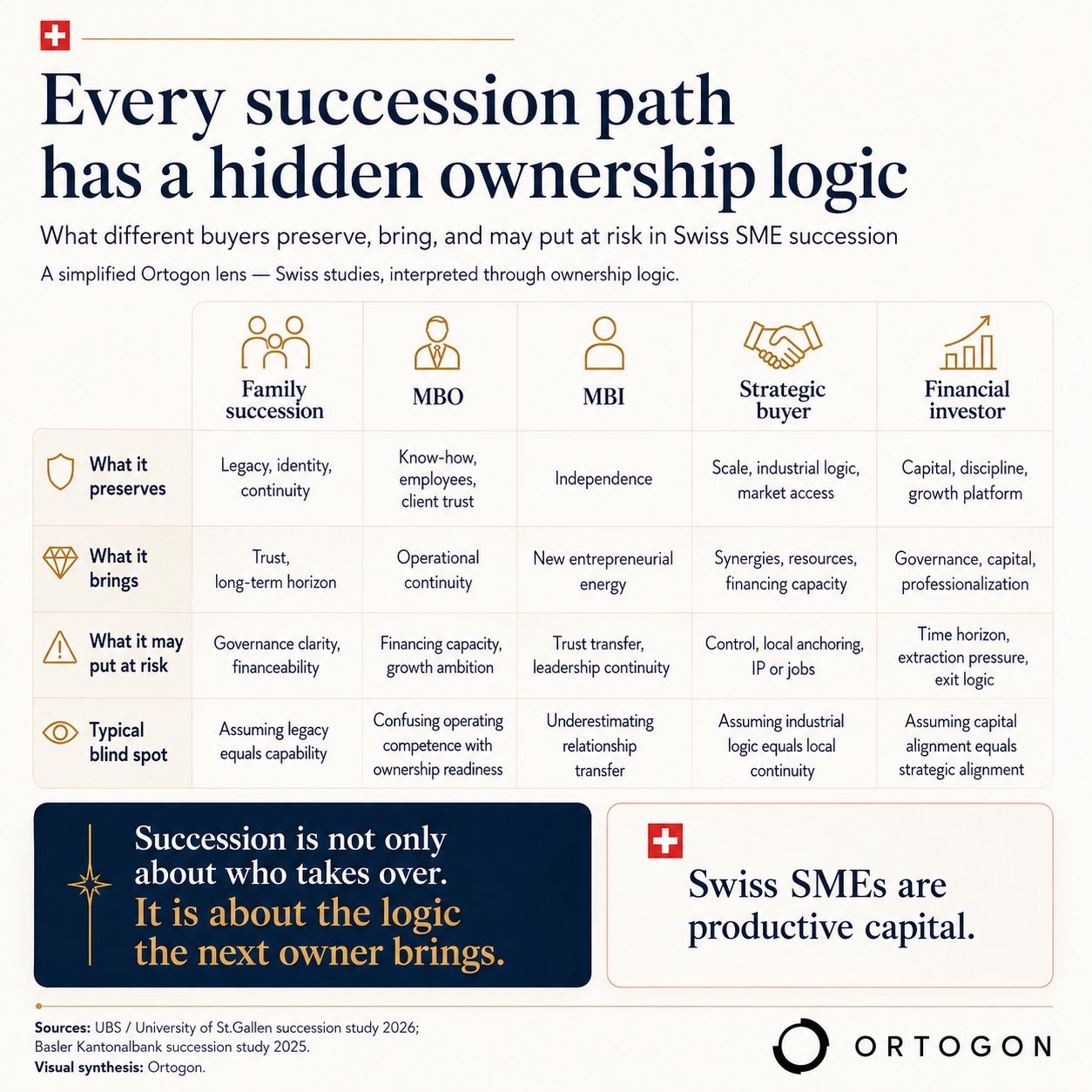
Every succession path carries an ownership logic. When an SME changes hands, the question is not only who will take over, but what incentives, time horizon and governance model the next owner will bring into the company.
A family successor may preserve identity, local anchoring and a long-term commitment to the enterprise. The same model can also bring unresolved family governance, limited capital or ambiguity between ownership and management.
A management buyout can preserve know-how, employee confidence and customer relationships. Its constraints are often financial: the management team may lack deep capital, and the transaction structure can leave the new owners heavily leveraged.
A management buy-in can introduce new entrepreneurial energy and external experience. The incoming leader must nevertheless establish legitimacy with employees, customers and suppliers while learning the company’s tacit operating logic.
A strategic buyer may offer scale, new markets, industrial synergies and greater investment capacity. It may also integrate the business into a broader group, relocate capabilities, absorb intellectual property or change the company’s local role.
A financial investor can bring capital, governance discipline and transaction expertise. The model generally comes with a defined return horizon, a focus on cash generation and an eventual exit objective.
None of these ownership models is inherently good or bad. They solve different problems and introduce different trade-offs. The appropriate choice depends on what must be preserved, what must change and what resources the company will need in its next phase.
Succession is therefore an ownership-architecture question. Buyer identity, financing, governance rights, investment horizon and exit logic should be considered as one system rather than as separate transaction terms.
With a large share of Swiss SMEs approaching succession, these choices will shape how productive capital is renewed, governed and anchored in the economy for years to come.