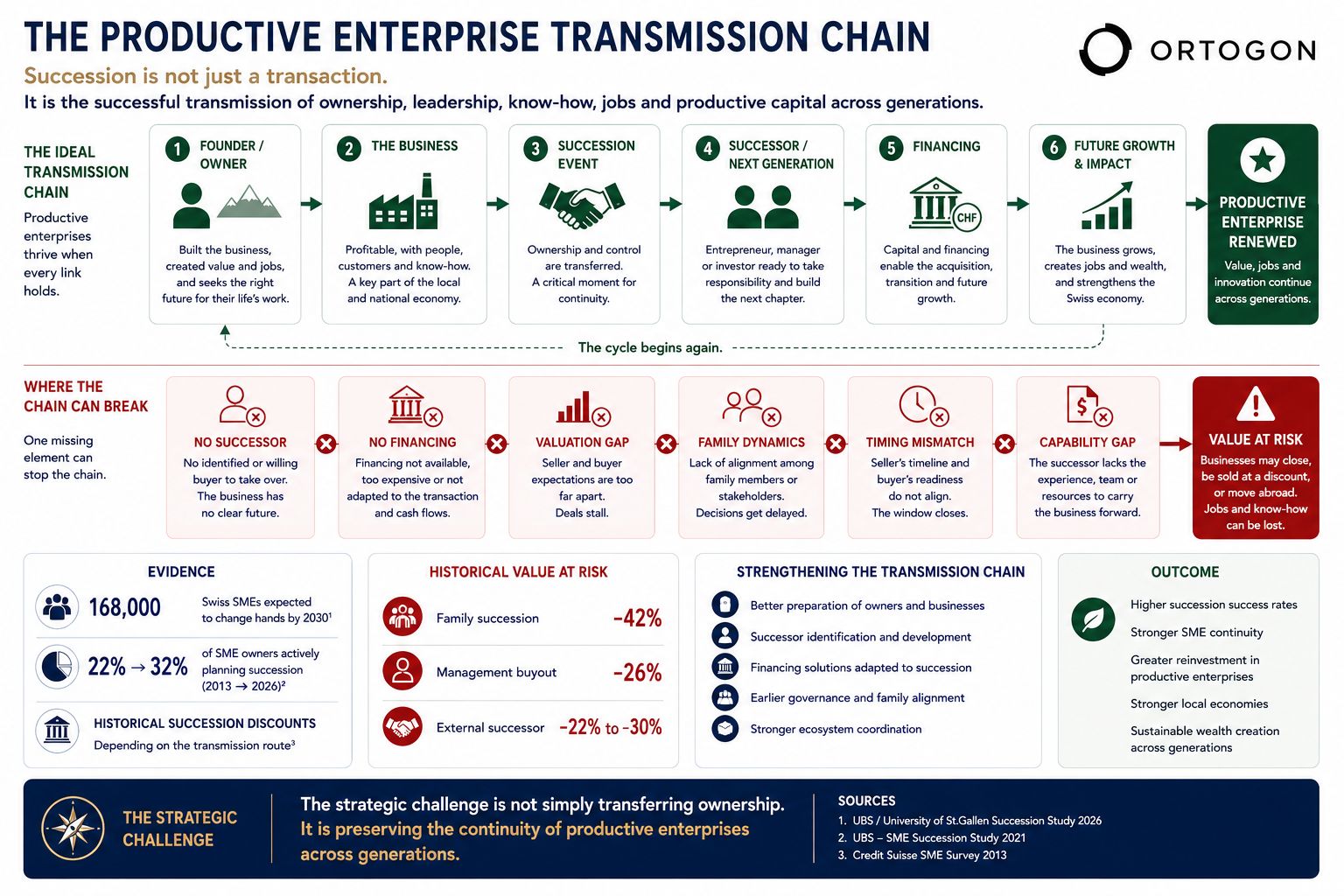
The main issues raised by Swiss succession studies can initially look separate: a record wave of transfers, valuation discounts, financing constraints and uneven successor readiness.
Taken together, they describe one underlying system. Succession is not a single transaction; it is a transmission chain through which a productive enterprise must pass from one generation of owners to the next.
That chain has several links. The business must be ready to be transmitted. A successor must be willing and able to lead. The valuation must be realistic. Financing must be viable. Stakeholders must be aligned. And the timing must allow the transition to be prepared rather than improvised.
A weakness in any one link can compromise the entire process. A viable company without a prepared successor may be sold under pressure. A capable successor without financing cannot complete the transfer. A financeable transaction built on an unrealistic valuation can leave the company too constrained to invest.
The consequences extend beyond shareholders. Jobs can disappear, know-how can be lost, customer and supplier relationships can weaken, and local economies can become less resilient.
This changes the objective of succession planning. The task is not simply to transfer legal ownership at a particular date. It is to preserve the continuity of a productive enterprise through a change in ownership, leadership and capital structure.
With around 168,000 Swiss SMEs expected to change hands by 2030, the quality of this transmission chain becomes a national economic issue. It affects how entrepreneurial knowledge, productive capacity and locally anchored capital pass from one generation to the next.
Strengthening the chain requires more than transaction advisers. It requires earlier preparation by owners, credible successor development, appropriate financing instruments, realistic valuations and coordination among families, managers, banks, investors and public institutions.
Succession is where wealth preservation and wealth creation meet. The strategic question is whether the ecosystem can transmit productive enterprises in a form that allows them to keep creating value after the founder leaves.