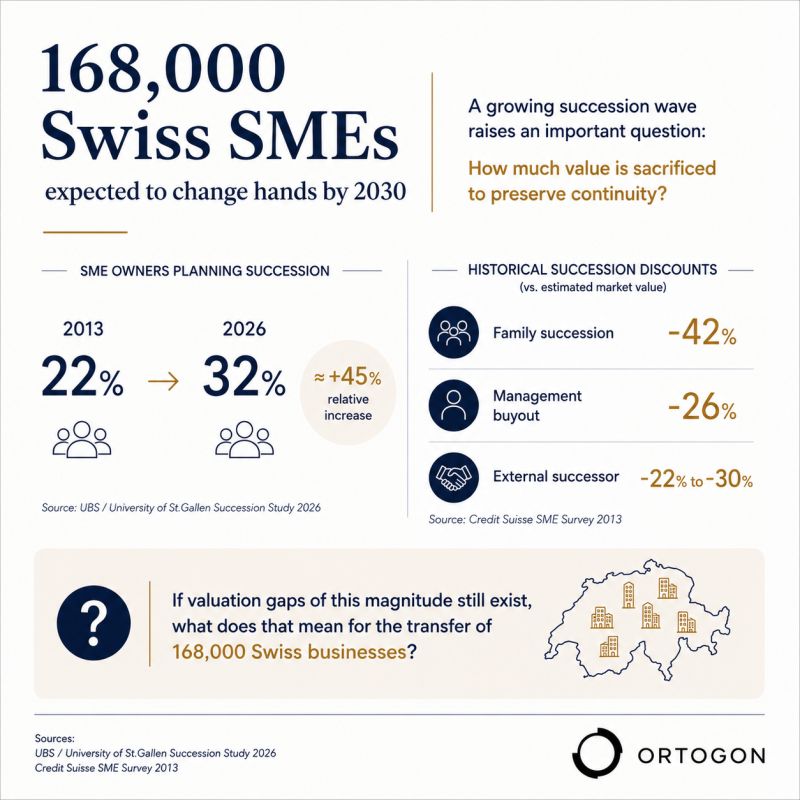
Around 168,000 Swiss SMEs are expected to change hands by 2030. According to the UBS and University of St. Gallen succession study cited in the source material, roughly 32% of Swiss SME owners were planning a transfer within the following five years, compared with about 22% in 2013.
The scale matters because these companies are not merely financial assets. Together, they represent jobs, know-how, customer relationships, local supply chains and a substantial share of Switzerland’s productive capital.
An earlier Credit Suisse and University of St. Gallen study adds a more surprising dimension. It found that founders often accepted significant discounts when transferring their companies: around 42% in family successions, around 26% in management buyouts and approximately 22-30% for external successors.
Viewed only through a valuation lens, those concessions can appear irrational. Entrepreneurs spend decades building value; why would they voluntarily give part of it away?
The answer is that many founders are not optimizing for price alone. The company may embody employees they feel responsible for, capabilities they want to preserve, customers they have served for years and an identity closely tied to their own life’s work.
A lower price, seller financing or more favourable terms can therefore be understood as part of the transmission itself. The founder is not simply selling an asset. In many cases, the founder is using part of the accumulated value to improve the chances that the business, its independence and its relationships will survive the transition.
This reframes succession as a capital-allocation question. The issue is not only how much wealth founders realize, but how productive wealth is transferred, to whom, on what terms and with what consequences for the next cycle of ownership.
As Switzerland enters this succession wave, the central question is how much productive wealth will be transferred below economic value in order to preserve continuity, independence and entrepreneurial stewardship - and whether the surrounding financial system is equipped to support that choice.