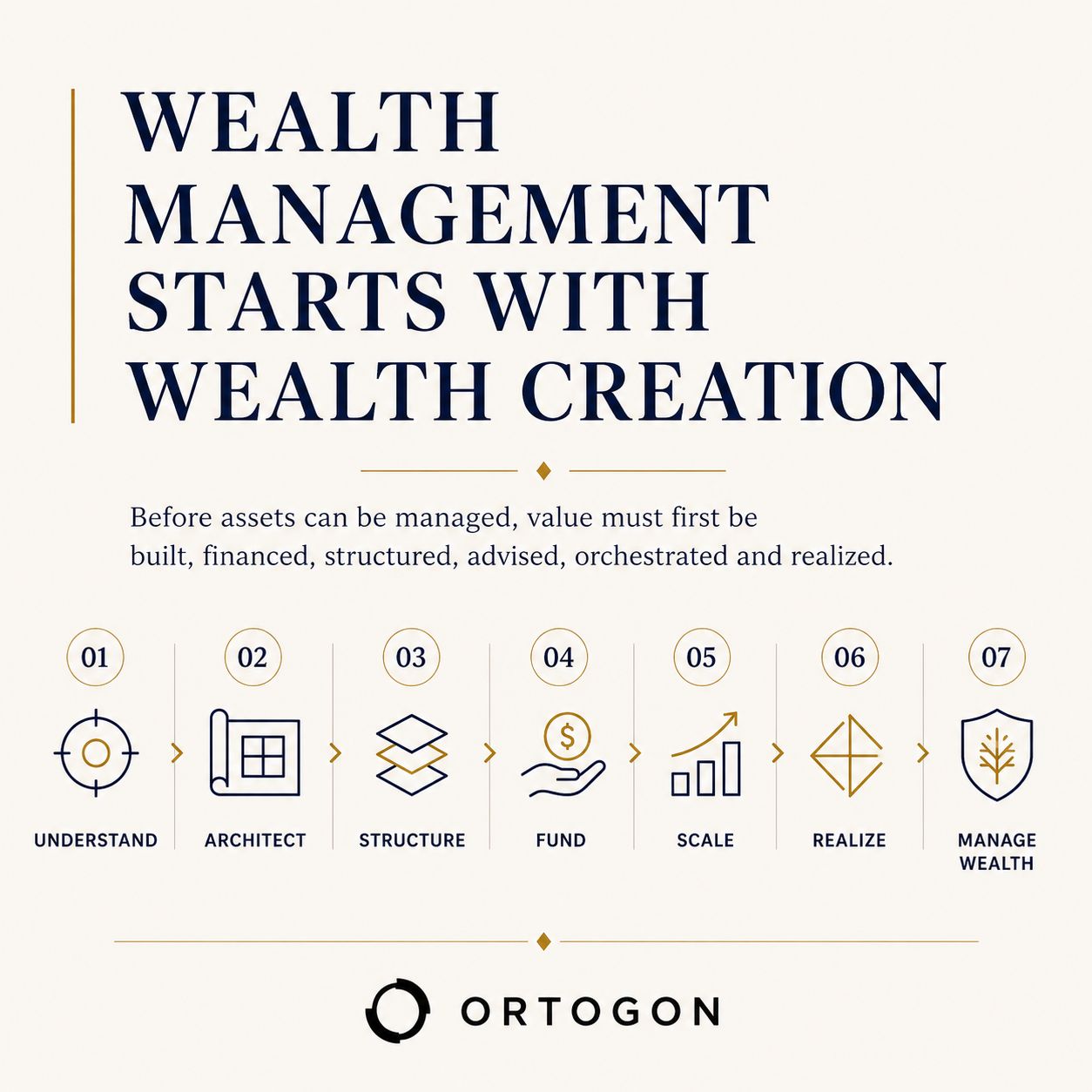
Wealth management starts with wealth creation. Yet many financial institutions enter the relationship only once assets are liquid, diversified and ready to be managed.
For entrepreneurs, founders, business owners and emerging high-net-worth clients, the most important financial work often begins much earlier. Before there is a portfolio, there may be a business to scale, cash flow to stabilize, credit to structure, risk to absorb, ownership decisions to make and value to realize.
The opportunity is therefore not merely to manage wealth after it exists. It is to help clients navigate the sequence that makes wealth liquid, resilient and manageable.
That sequence begins with understanding the client’s goals, constraints and ambitions. It then requires a target architecture: how business ownership, personal assets, debt, collateral, liquidity and governance should fit together.
Capital must subsequently be structured and funded through an appropriate combination of reinvestment, institutional debt and private capital. The business may need to scale before risk can be reduced, ownership diversified or value realized through dividends, a partial sale or an exit.
Only after that process does conventional wealth management fully come into view: diversifying liquid assets, protecting purchasing power, managing risk and preparing the transmission of private wealth.
This is where wealth managers can create meaningful differentiation. Not by presenting more products or replicating private-banking imagery earlier, but by becoming relevant before the liquidity event—before assets are fully bankable and before the client’s most important financial relationships have been built elsewhere.
The central client question is not simply how to allocate an existing portfolio. It is how to turn income, business value and growth potential into resilient, liquid and manageable wealth.
Institutions that can support that transition connect wealth management to its source. They do not wait for wealth to arrive; they help organize the path through which it is created.