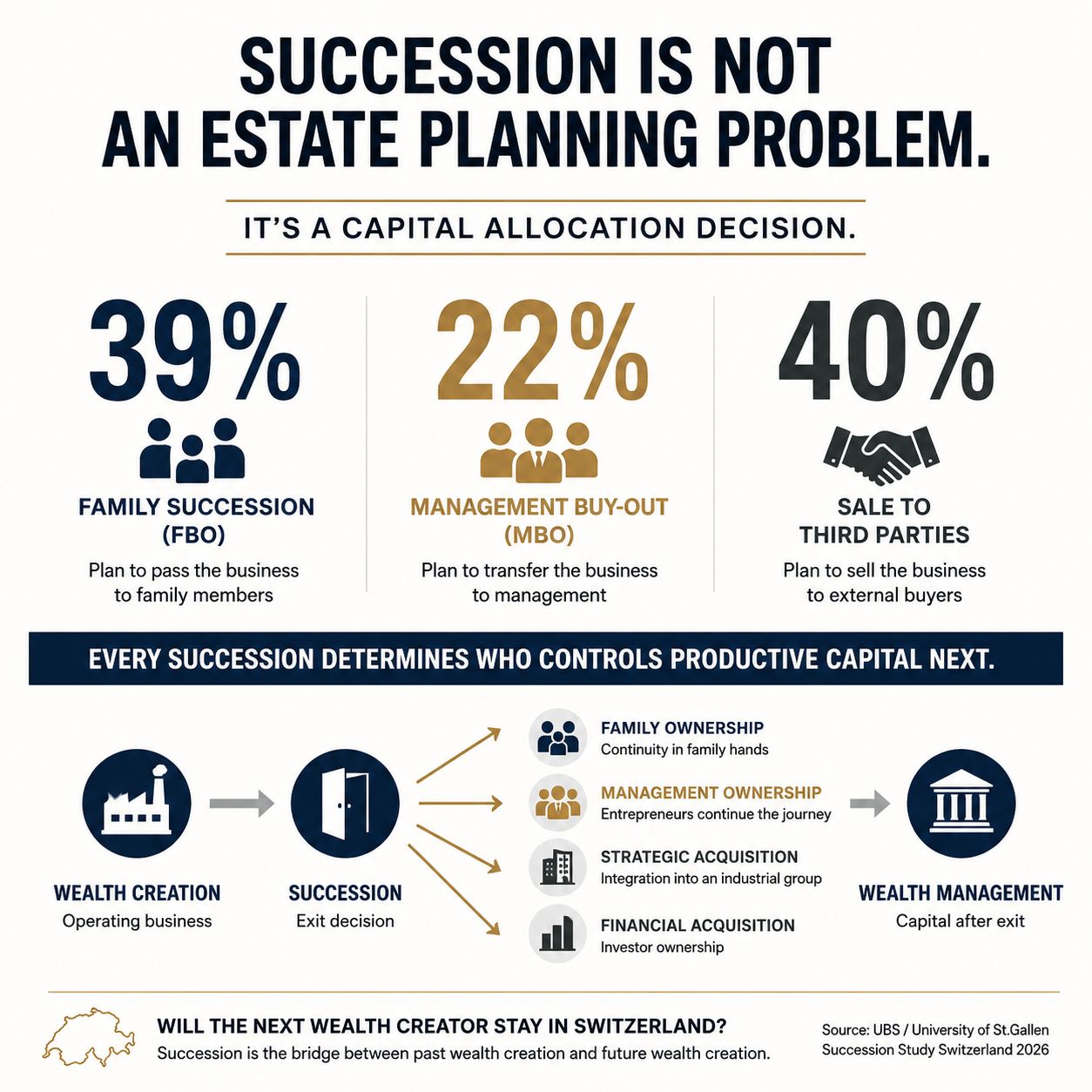
Business succession is usually approached as a family, legal or tax matter. Those dimensions are essential, but they do not capture the whole transition.
Succession is also a decision about what happens to productive capital. It determines who will own the next chapter of the company, who will finance it and who will take the risk of developing it further.
For the founder, the transaction may convert decades of productive capital into private wealth. For the successor, it marks the beginning of a new wealth-creation cycle. For the wider economy, it is one of the mechanisms through which productive assets are renewed, transferred or transformed.
These three transitions are linked. A structure that protects the founder but leaves the successor overleveraged can weaken the company. A structure that preserves the business but leaves the founder financially exposed may be equally unsustainable. A structure that works for both parties but starves the company of investment can compromise the next phase of growth.
The challenge is therefore not to choose between wealth preservation and wealth creation. A healthy succession must do both: protect the value accumulated by one generation while giving the next generation the ownership, capital and strategic room required to create value again.
This is also a test of the financial system. Institutions are generally well equipped to preserve and manage liquid wealth. The harder question is whether they are equally effective at financing entrepreneurs, ownership transfers, business renewal and the years of investment that often follow a succession.
Succession is where the relationship between wealth management and wealth creation becomes visible. The liquidity produced by one entrepreneurial cycle must be protected and allocated, while the productive company must enter another cycle under viable ownership and financing conditions.
Seen in this light, succession is not just an estate-planning problem. It is a mechanism of productive renewal—and one of the places where the long-term resilience of an economy is decided.