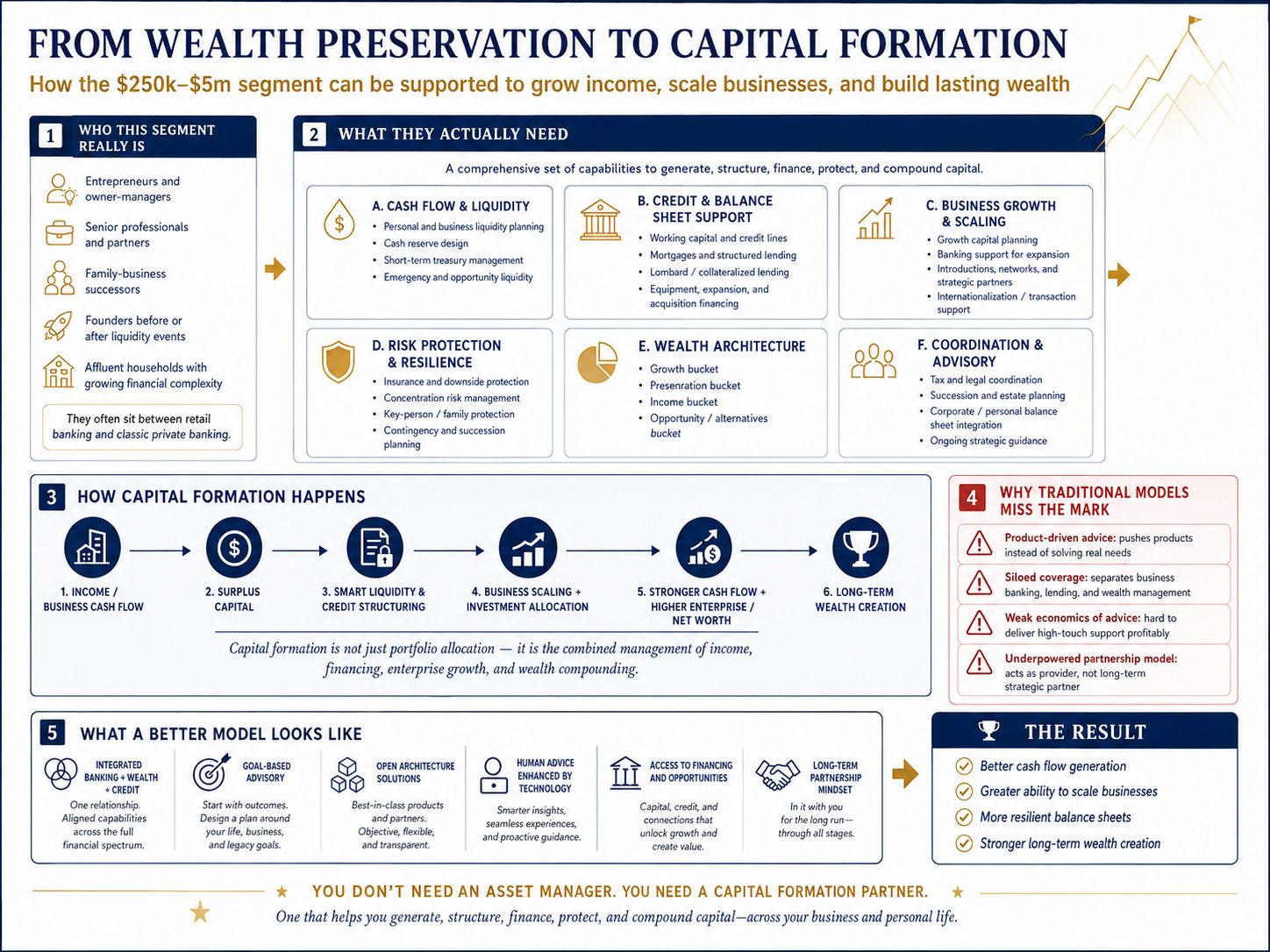
Clients with roughly CHF 250,000 to CHF 5 million in financial capacity are often described as an underserved segment between retail banking and traditional private banking. The common response is to offer them private banking earlier or more efficiently.
That diagnosis is incomplete. Many of these clients do not only need wealth management. They need capital formation.
They are often entrepreneurs, senior professionals, business owners, founders before a liquidity event, family-business successors or first-generation wealth creators. They are still actively converting income, expertise, ownership and risk-taking into durable capital.
Their questions are therefore more practical and interconnected than a conventional asset-allocation exercise. How much income can become investable surplus? How much capital must remain liquid? How much can be reinvested in the business? How should credit be structured without creating fragility? How can personal wealth be diversified beyond the operating company?
They may also need to coordinate business cash flow, private debt, future liquidity events, recurring income, protection and long-term investment. Buying a portfolio addresses only one layer of that system.
This segment sits between two institutional models. Retail banking is generally product-led, centred on accounts, deposits, mortgages, basic credit and packaged investments. Traditional private banking is usually portfolio-led, centred on mandates, asset allocation, preservation and succession.
A capital-formation partner would connect the layers that fall between those models: the household balance sheet, business cash flow, borrowing capacity, investable assets, entrepreneurial risk, ownership, protection and the transition toward liquid wealth.
Serving the segment well is therefore an operating-model challenge. It requires institutions to make integrated advice economically viable at scale through a disciplined combination of advisory, credit, liquidity planning, business-owner support, open architecture, technology and governance.
The opportunity is not to sell private banking earlier. It is to help emerging wealth become productive, resilient and scalable capital.
The institutions that succeed will not necessarily be those with the broadest product shelf. They will be those that understand that wealth formation begins before wealth is fully bankable.