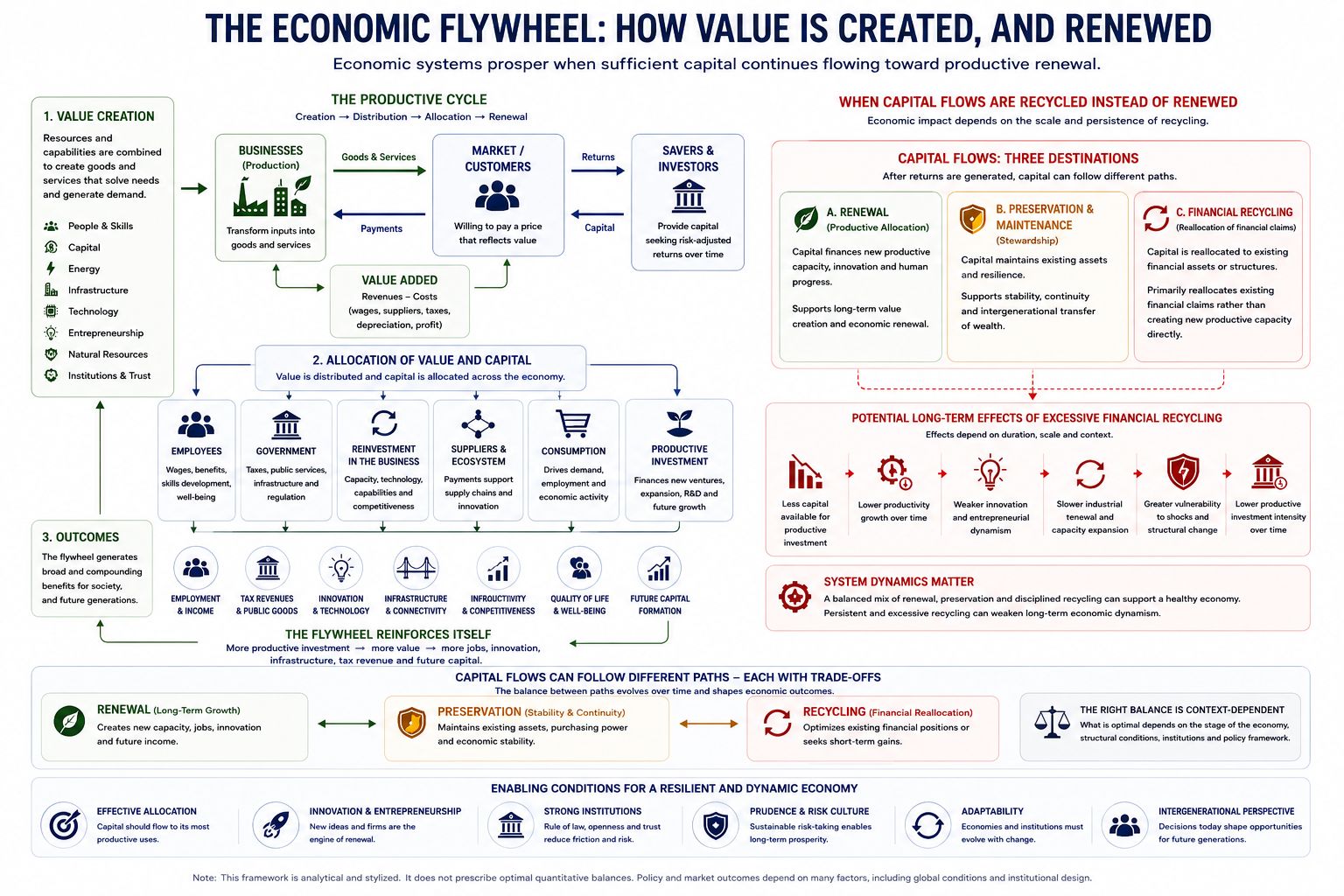
An economy does not sustain itself through capital preservation alone. It depends on the continuous renewal and expansion of productive capacity.
At the centre of that process are companies. They combine labour, capital, energy, infrastructure, technology, logistics and risk to produce goods and services that the market values more than the total resources required to create them.
The resulting profits are then reinvested, distributed, taxed, consumed, saved or reallocated. When enough of that capital returns to productive activity, it supports employment, innovation, infrastructure, productivity growth, tax revenues and future capital formation.
This is the economic flywheel: productive capacity creates value; value creates profits and income; those resources finance investment; investment renews and expands productive capacity.
Not every form of capital allocation performs the same function. Some capital expands capacity. Some maintains existing systems, improves efficiency or protects accumulated wealth. All of these functions are necessary.
The important distinction is between financing productive expansion and recirculating capital and cash flows that have already been created. Financial circulation can remain active for long periods without materially enlarging the productive base underneath it.
If capital progressively concentrates on refinancing existing assets, collateral-driven lending, balance-sheet optimization and financial recycling while productive expansion becomes relatively underfunded, the effects may initially be difficult to see.
Over time, however, weaker productivity growth, slower industrial renewal, lower entrepreneurial dynamism and a declining capacity to finance long-duration projects begin to reinforce one another.
Economies do not compound primarily through the preservation and circulation of existing wealth. They compound through the repeated creation of new productive capacity beneath it.
Capital allocation therefore shapes more than financial returns. It helps determine the long-term trajectory, resilience and renewal capacity of the economy itself.