After discussing discouraged SME borrowers and collateral-driven lending dynamics earlier this week, another figure deserves attention.
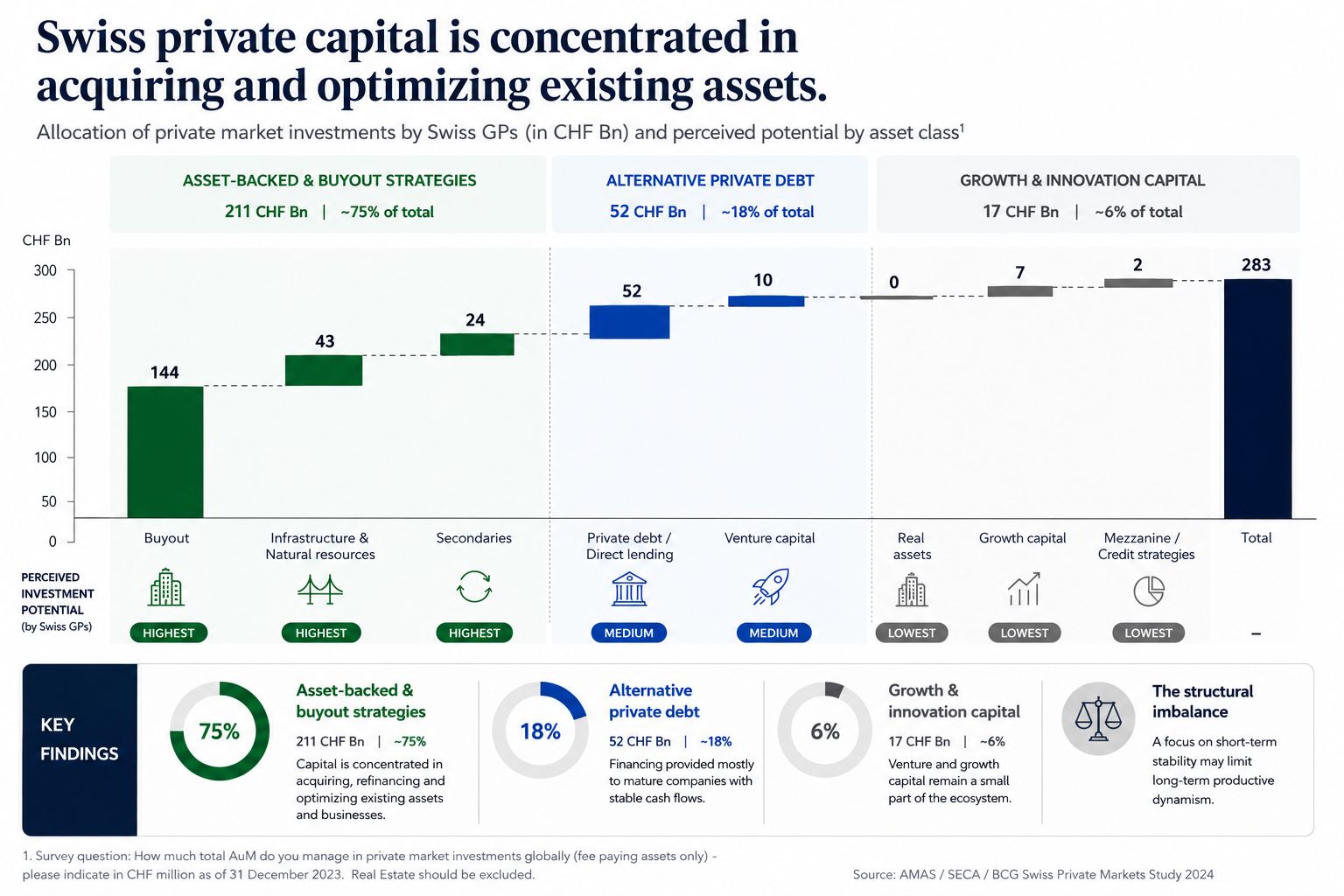
According to the Asset Management Association Switzerland / SECA - Swiss Private Equity & Corporate Finance Association / Boston Consulting Group (BCG) Swiss private markets study, roughly 75% of Swiss private market allocations are concentrated in:
- buyouts
- infrastructure
- secondaries
- other mature asset-backed strategies
Meanwhile, venture capital and growth capital represent only a very small share of total allocations.
That raises a deeper structural question.
Is Switzerland increasingly optimized to finance:
- the acquisition
- refinancing
- optimization
- preservation of existing assets
more than the creation of new productive capacity?
Because this mirrors another trend already visible in SME lending: capital increasingly flows toward collateral-rich and mature structures.
That naturally favors:
- existing asset holders
- mature companies
- real-estate-backed balance sheets
- lower-volatility financing models
That may improve short-term financial stability.
But over time, what are the consequences for:
- younger companies without accumulated collateral
- industrial and deep-tech ventures requiring long investment cycles
- innovation-heavy businesses built around IP rather than hard assets
- broader economic renewal?
The question is therefore not whether risk should disappear.
It is whether the system still allocates enough capital toward building future productive capacity - not only preserving existing one.
Because financial systems ultimately shape the type of economy a country becomes.