Switzerland became rich through productive capital formation before becoming rich enough to specialize in wealth preservation.
Not the other way around.
Swiss prosperity was built through:
- industrial development
- engineering
- entrepreneurship
- export industries
- long-term capital investment
But today, the financial system increasingly appears optimized for preserving and reallocating existing wealth rather than financing new productive capacity.
Over the past decade:
- SME credit growth became increasingly mortgage-backed
- private markets concentrated heavily around buyouts and mature asset-backed strategies
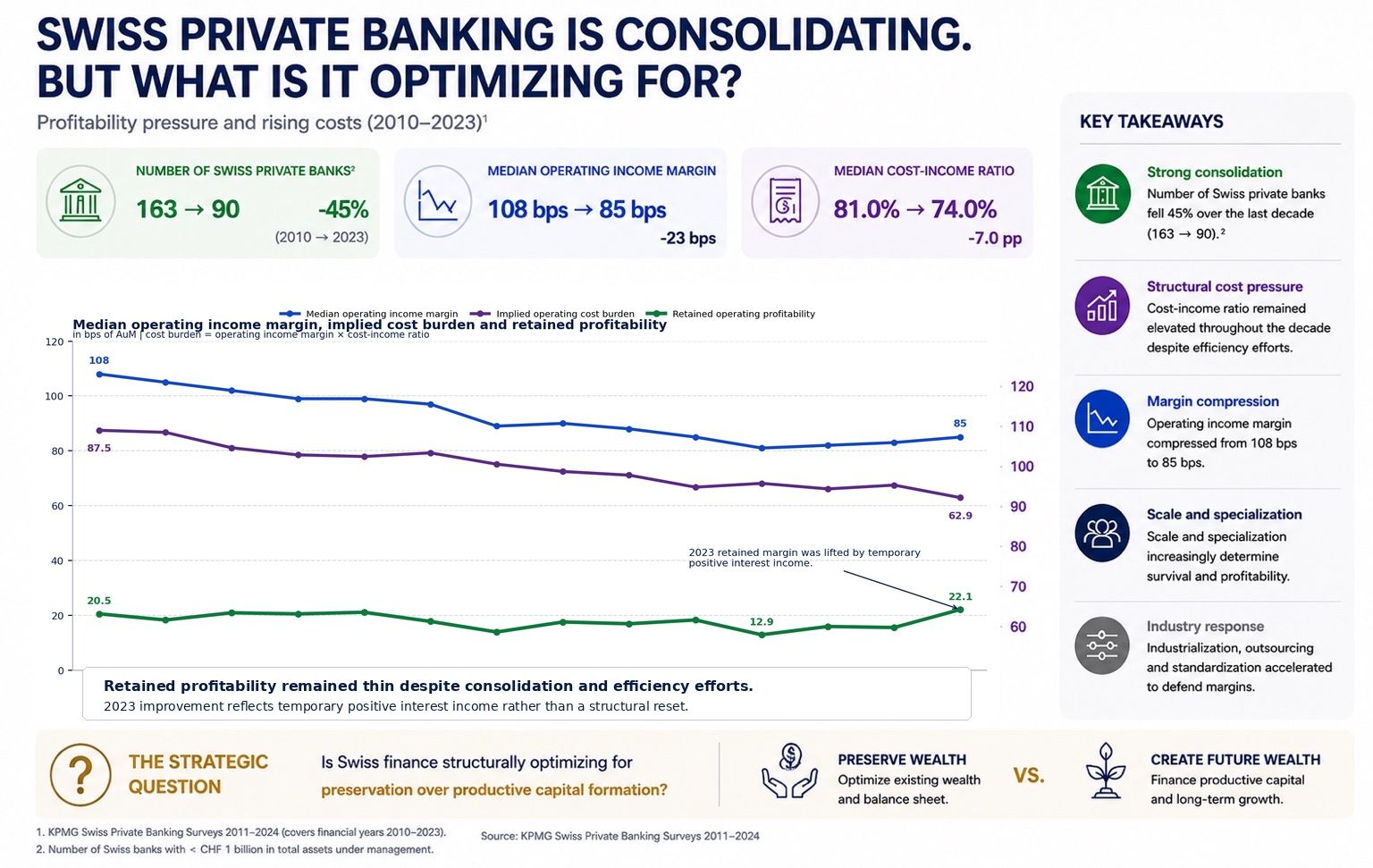
- Swiss private banking underwent intense consolidation and industrialization pressure
KPMG Switzerland longitudinal data found in Clarity on Swiss Private Banks shows:
- operating income margins compressed structurally
- retained profitability remained thin
- efficiency gains increasingly offset declining revenue economics rather than creating new growth capacity
Even the recent improvement in profitability was largely driven by temporary positive interest income.
The question is therefore not whether Switzerland has capital.
It clearly does.
The question is where that capital structurally flows, if SMEs are discouraged to ask for borrowing, banks increasingly lend against collateral, private markets increasingly optimize existing assets.
who finances:
- industrial renewal
- scaling companies
- deep tech
- infrastructure transition
- long-duration productive risk?
Because capital preservation and capital formation are not the same economic function.
And over time, economies that optimize preservation more than renewal lose productive dynamism.