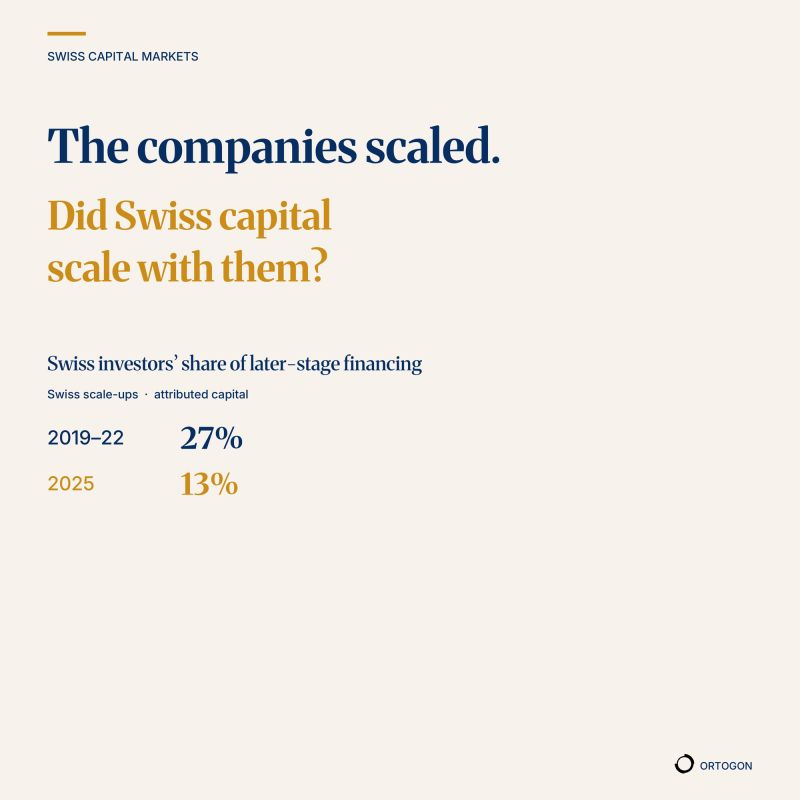
Swiss investors provided 27% of attributed later-stage financing of Swiss scale-ups in 2019–22. In 2025, their share was 13%.
That does not necessarily mean Swiss investment fell in absolute terms. Foreign capital may simply have grown faster and the Swiss Scale-Up Report 2026 indicates that this is at least part of the explanation.
What the number does show is that the portion of Swiss capital is becoming relatively less important as Swiss companies scale.
This is happening in a country with extraordinary pools of savings and a strong innovation engine: 265 identified scale-ups, 64% in deep tech, and more than CHF 13bn of later-stage capital raised since 2012.
At the same time, the CHF bond market demonstrates substantial institutional absorption capacity. In 2026, US AI-related companies have accounted for 26.4% of CHF corporate bond issuance, including multi-billion-franc issues from Alphabet and Amazon.
These are different markets and different risks.
The comparison is revealing because Switzerland evidently has capital willing to finance high-tech productive investment at scale.
The question is whether it still has sufficient financial machinery to connect Swiss savings with productive opportunities at home.
That was the central question of my recent article. Over the next few posts, I want to examine what might sit between the two.