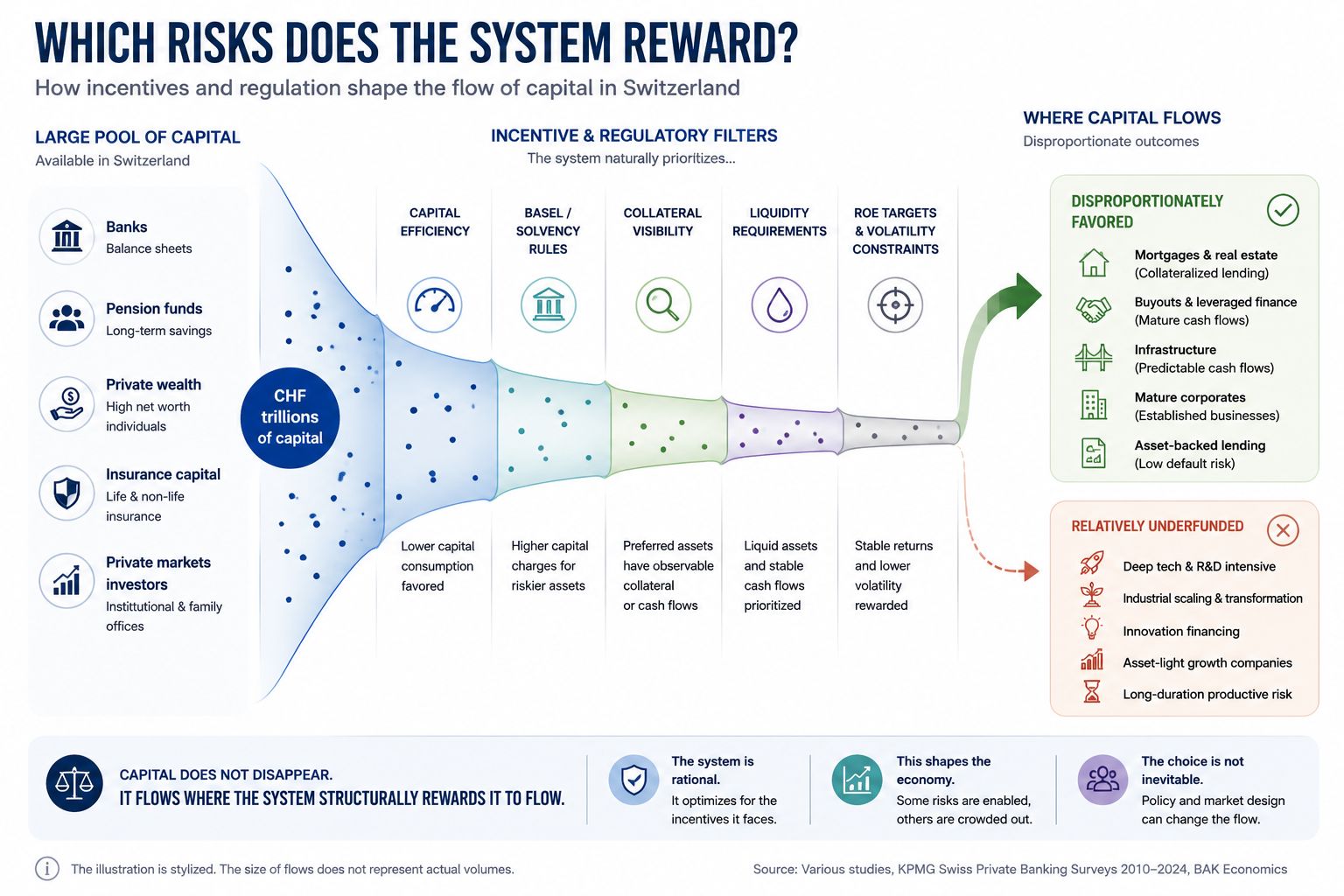
One of the most important questions is not whether financial institutions take risk.
It is which types of risk the system structurally incentivizes them to take.
A collateralized mortgage loan, a buyout backed by mature cash flows, and long-duration financing for an emerging industrial company do not consume capital, volatility tolerance or regulatory attention in the same way.
Over time, this matters.
Because financial institutions optimize within incentive systems:
- regulatory capital frameworks
- solvency constraints
- liquidity requirements
- return-on-equity targets
- balance-sheet efficiency
Naturally, this pushes capital toward collateralized lending, mature cash flows, asset-backed financing, and lower-volatility activities.
Not because institutions are irrational.
But because the system increasingly rewards capital preservation and capital efficiency.
The consequence is subtle but important.
Financing becomes structurally easier for:
- existing asset holders
- mature businesses
- real-estate-backed companies
- established cash-flow profiles
And structurally this makes it harder for:
- long-duration innovation
- industrial transformation
- deep tech
- asset-light growth companies
- productive risk without immediately pledgeable collateral
This is not simply a banking question.
It is a capital allocation architecture question.
And over time, the way a system prices and allocates risk shapes the type of economy that emerges from it.