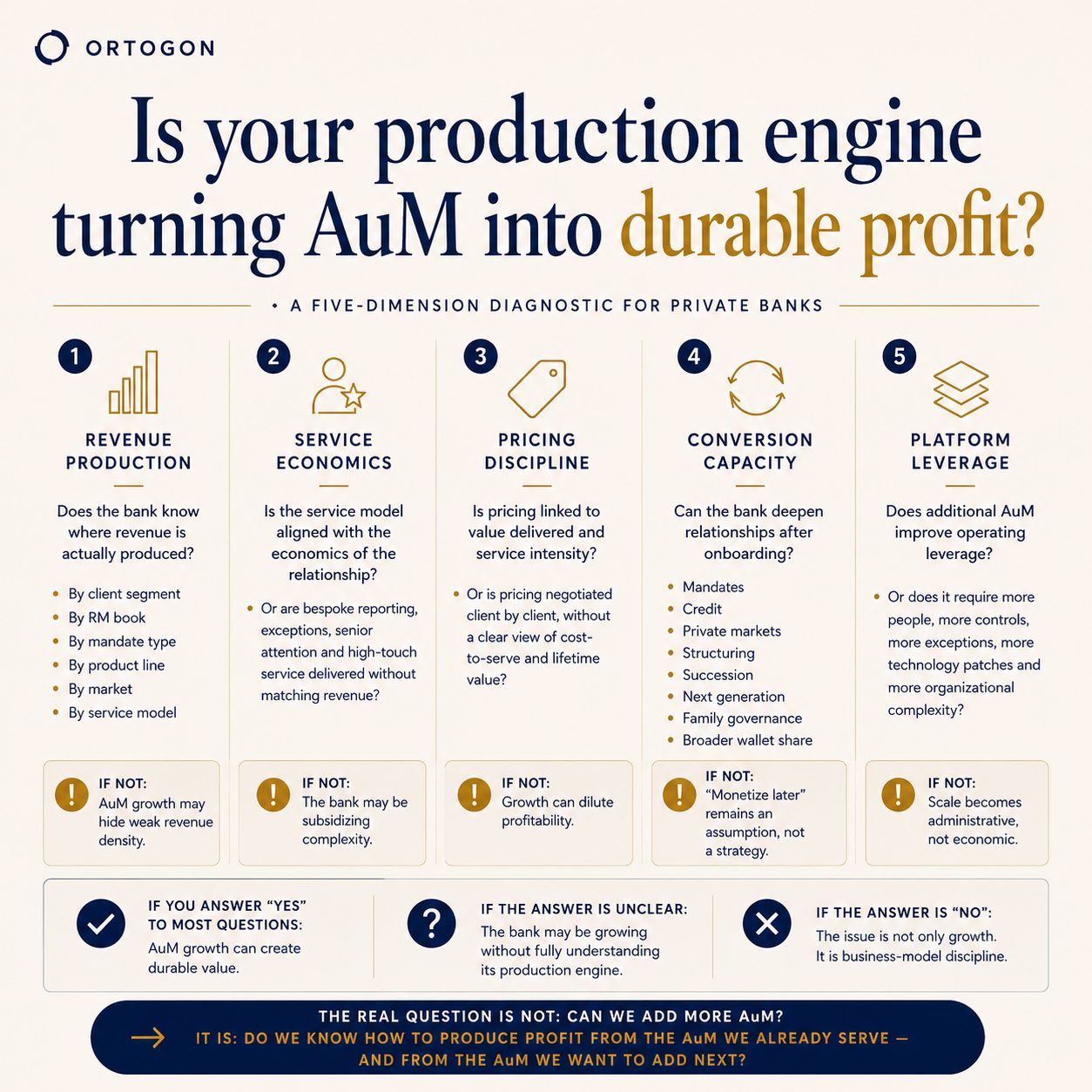
Most private banks know how much AuM they manage. Fewer can answer with the same discipline how those assets become durable profit. The following checklist provides a practical way to test the production engine across five dimensions.
1. Revenue production. Does the bank know where revenue is actually produced—by client segment, RM book, mandate type, product line, market and service model? If not, AuM growth may be concealing weak revenue density.
2. Service economics. Is the service model aligned with the economics of the relationship? Bespoke reporting, exceptions, senior attention and high-touch service may be entirely justified, but only when their cost and strategic purpose are understood. Otherwise, the bank may be subsidizing complexity without realizing it.
3. Pricing discipline. Is pricing linked to value delivered, service intensity and cost-to-serve? Or is it negotiated client by client without a coherent view of relationship economics and lifetime value? Weak pricing discipline allows growth to dilute profitability.
4. Conversion capacity. Can the bank deepen a relationship after onboarding through mandates, credit, private markets, structuring, succession planning, next-generation engagement, family governance and broader wallet share? If not, the promise to monetize later remains an assumption rather than a strategy.
5. Platform leverage. Does additional AuM improve operating leverage, or does it require proportional increases in people, controls, exceptions, technology patches and organizational complexity? If every increment of scale adds an equivalent administrative burden, the scale is operational rather than economic.
The interpretation is straightforward. A bank that can answer yes to most of these questions has a credible basis for turning AuM growth into durable value. Unclear answers indicate that the bank may be growing without fully understanding its production engine.
Repeated negative answers point to a business-model problem rather than a growth problem. Adding more AuM to the same system is unlikely to correct the underlying economics.
The final question is therefore not simply whether the bank can gather more assets. It is whether it knows how to produce profit from the assets it already serves—and from the assets it intends to add next.
That is the discipline of the production engine: understanding, measuring and improving the mechanisms that convert AuM into durable economic value.