A large part of what a private bank really knows about its clients still sits with its Relationship Managers.
I wrote about this in SPHERE The Swiss Financial Arena in June, mostly from the bank's perspective: how do you turn that fragmented, often implicit knowledge into something the institution can actually retain and use?
But there is another side to the question that I find increasingly interesting.
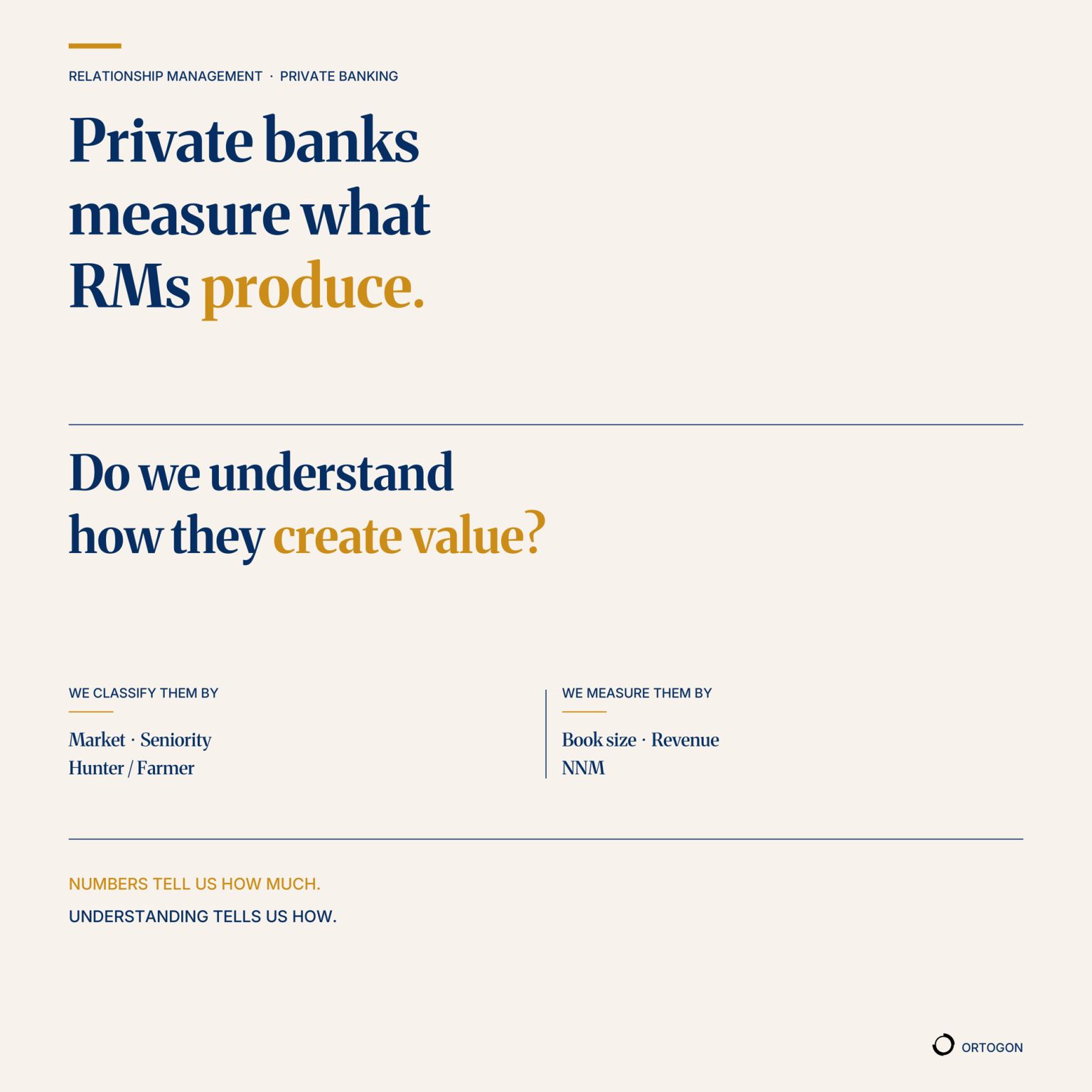
We spend a lot of time measuring RMs: book size, revenues, NNM, activity. We classify them by market, seniority, often as Hunters or Farmers.
None of this tells us very much about why a client actually values one RM rather than another.
Some RMs are extraordinarily good at developing relationships. Others have the judgement that makes clients call them before an important decision. Some build a level of trust that gives them access to information nobody else has. Others are at their best when a complex situation requires the right people, inside and outside the bank, to come together.
These differences are obvious when you have worked with RMs for long enough. Yet we have surprisingly little vocabulary for them.
And that matters beyond description.
The same client book will not make equally good use of every RM. The same development programme should probably not be applied to all of them. And two RMs producing similar numbers may be creating very different kinds of value underneath.
This is the question that led us to start working on RM archetypes at MercuryMetrics:
Can we describe how an RM creates value before we start judging how much value they produce?
More on this shortly.