Capital markets lose competence before they lose infrastructure.
Switzerland still has the exchanges, banks, advisers and enormous pools of capital.
What it may be losing is harder to see: the repeated practice of taking productive risk to market.
Look at public equity:
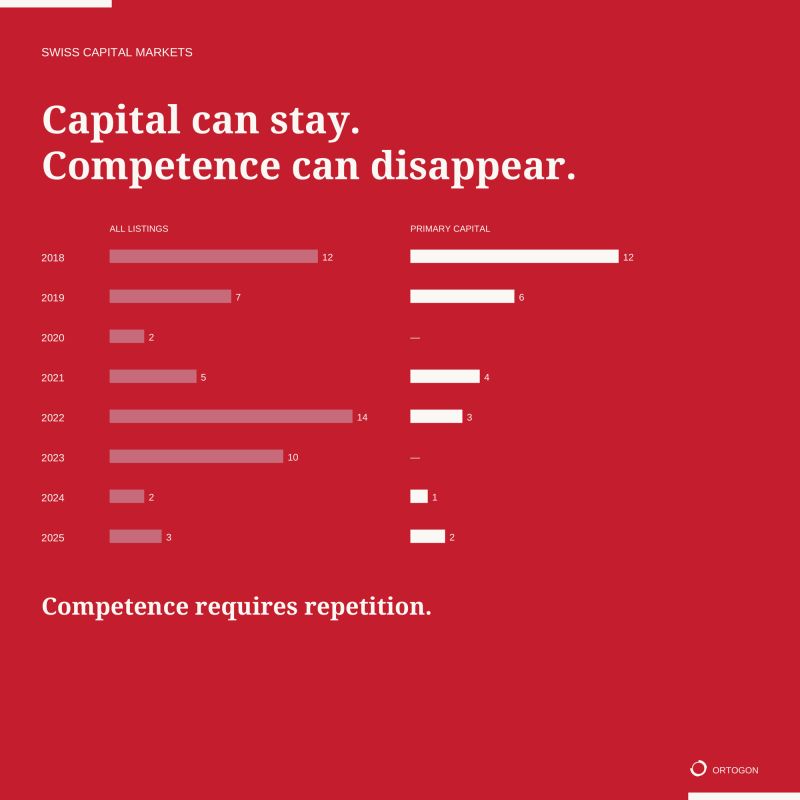
In 2018, SIX had 12 listings that included primary capital formation.
Since then, genuine primary issuance has become increasingly episodic.
The headline numbers obscure this. There were 14 listings in 2022 and 10 in 2023.
Once GDRs, spin-offs, SPAC/RTO combinations, purely secondary transactions and listings without new equity are removed, we identify around 3 primary-capital transactions in 2022 and none in 2023.
Primary capital here means a listing that issued new equity for the company.
Why does this matter?
Because transactions don’t only raise money:
- They produce competence.
- Bankers and the ecosystem learn how to structure and price risk.
- Analysts build sector knowledge.
- Investors learn which questions to ask.
- Management teams learn how to access markets.
- Brokers develop distribution.
- Liquidity attracts more liquidity.
Do that repeatedly and a market develops depth.
Stop doing it often enough and the process reverses.
Teams disappear. Research becomes uneconomic. Investor knowledge migrates elsewhere. Fewer people know how to structure the next transaction. And eventually companies go where that competence still exists.
This is difficult to observe because the infrastructure remains standing while the capability underneath it erodes.
One signal is already visible: around half of SIX-listed companies have only one analyst covering them or none. SIX has responded with a Research Hub to help close that gap. But research coverage is probably a symptom of something larger.
The same pattern is beginning to appear across the areas we have been examining: complex corporate credit, growth capital, public equity, specialist underwriting.
Market depth is accumulated competence. And accumulated competence requires repetition.
Once lost, it cannot be recreated simply by allocating more capital or building another platform. It takes transactions, people, judgment, mistakes, track records and time.
That is why the shallowness of Swiss capital markets matters.
Capital can move overnight. Competence takes years to rebuild.
What is your experience around this?